
My third-great-grandparents François LeFort and Julie lived in south Louisiana during the first decades of the nineteenth century. I have been able to follow their family through church, civil and succession records, but those records also leave questions that I have not been able to answer.
The greatest question concerns Julie. She was born Julie Landry, daughter of Agnes Landry, but the baptismal records of the three children she had with François LeFort identify their mother as Julie Hébert. François’s own death record also identifies his wife as Julie Hébert LeForte.
There was another Julie Hébert living in the area at the same time, and she is often identified in online family trees as François’s wife. The records show that she was a different woman.
François presents another problem. His death record says he was a native of France and places his birth at about 1786. There are many possible François LeForts in French records and in online trees. I have not yet found the evidence that connects the François who lived in Louisiana to one particular family in France.
What follows is what I can document about François, Julie and their three children.
Julie Landry
Julie Landry was born December 17, 1805, in St. Martin Parish and baptized February 16, 1806, at St. Martinville.
Southwest Louisiana Records (SWLAR) abstracts her church record as:
LANDRY, Julie (Agnes LANDRY), b. 17 Dec. 1805, bt. 16 Feb. 1806; sponsors Hubert Landry and Roselie Louviere; Father Gabriel Isabey (SM Ch.: v. 6, #310).
Only her mother, Agnes Landry, is named as a parent.
Julie’s baptismal sponsors also connect her firmly to her mother’s family. Hubert Landry was Agnes’s brother, making him Julie’s maternal uncle. Rosalie Louviere appears to have been the daughter of Agnes’s sister Françoise Landry, making her Julie’s first cousin.
Agnes Landry was the daughter of Firmin Landry and Théotiste Thibodeau. SWLAR records Agnes’s baptism on December 11, 1784, in St. Martin Parish.
On April 14, 1806, less than two months after Julie’s baptism, Agnes married Pierre Perault. The SWLAR marriage entry identifies Agnes as the adult daughter of the deceased Firmin Landry, of La Fausse Pointe, and Théotiste Thibodeau. Pierre Perault was identified as being from Montreal, Canada, the adult son of the deceased Nicolas Perault and Clarisse LeBlanc.
Agnes and Pierre later had a daughter, Claire Perault, born April 13, 1808. SWLAR identifies Claire as the daughter of Pierre Perault and Agnes Landry (SM Ch.: v. 6, #899).
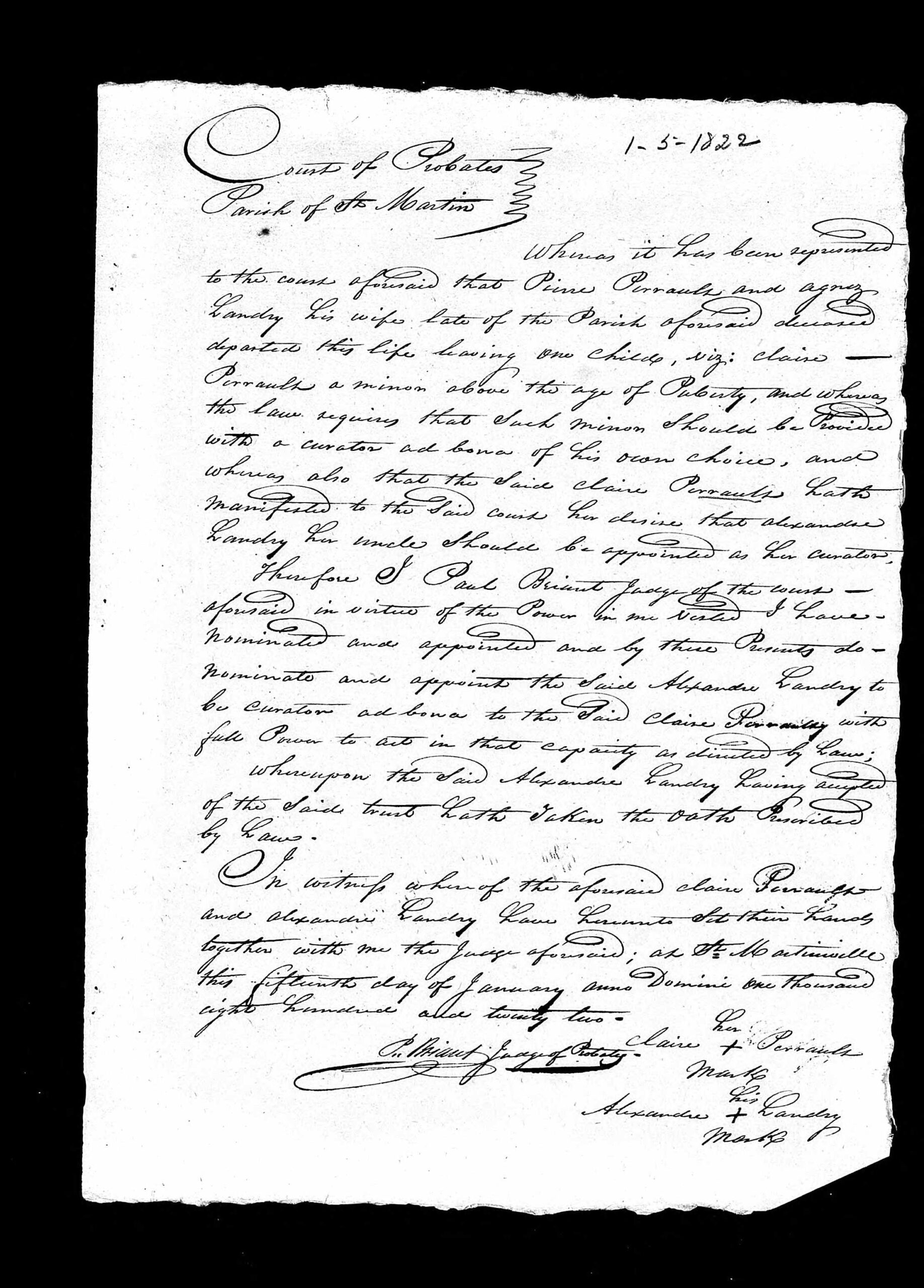
Both Pierre Perault and Agnes Landry were deceased by January 5, 1822. An original St. Martin Parish court proceeding on that date concerns their minor daughter Claire and identifies Alexandre Landry, another of Agnes’s brothers, as the uncle Claire selected to serve as her curator.
Exactly when Agnes and Pierre died has not been determined. This leaves an important gap in Julie’s life. We do not know how old Julie was when her mother died, where she lived afterward, or if she herself ever used the surname Hébert.
François LeFort and Julie
No marriage record has yet been found for François LeFort and Julie.
Such a record would be especially valuable. It might tell us whether Julie was identified as Landry or Hébert at the time and might provide witnesses or other information that could help explain the two surnames.
François and Julie had three known children: Julie, Virginie and Joseph LeFort.
Their eldest known child, Julie LeFort, was born July 26, 1824. Southwest Louisiana Records (SWLAR) abstracts her record as: “LEFORT, Julie (Francois & Julie HEBERT) b. 26 July 1824 (Laf. Ch.: v. 2, #16).” A certificate obtained from the Cathedral of St. John the Evangelist provides the additional information that she was baptized December 26, 1824.
Their daughter Virginie LeFort was baptized April 15, 1827, at about six months of age. SWLAR abstracts the record as:
LEFORT, Virginie (François & Julie HEBERT), bt. 15 April 1827 at age 6 months; sponsors Andre Martin and Valery Neveux (Laf. Ch.: v. 2, #352).
Their son Joseph LeFort was baptized November 23, 1829, at about eleven months of age. His parents were again recorded as François LeFort and Julie Hébert.
All three known children’s baptismal records therefore identify their mother as Julie Hébert.
Yet François’s wife is also documented as Julie Landry.
Julie Landry died May 15, 1833, in Lafayette Parish. SWLAR abstracts her death record as: “LANDRY, Julie m. Francois LEFORET d. 15 May 1833 at age 30 yrs. (Laf. Ch.: v. 3, p. 33).” Although the age given would place her birth about 1803 rather than December 1805, age discrepancies of a few years were common in records of this period. More importantly, the record identifies her by the surname Landry and as the wife of François LeForet.
François survived her by about three and a half years.
One of the strongest records connecting the names Landry and Hébert comes from their daughter Virginie.
Virginie’s baptismal record, as shown above, identifies her parents as François LeFort and Julie Hébert. When she married Octave Richard on November 30, 1846, however, SWLAR abstracts the record as:
LEFORT, Eugenie, 19 years old (François & Julie LANDRY) m. 30 Nov. 1846 Octave RICHARD (Laf. Ch.: v. 3, p. 228).
The use of Eugenie appears to be a variation or possible error for Virginie. More important for identifying her mother is that the same daughter whose baptism names Julie Hébert as her mother has a marriage record naming Julie Landry.
Taken together with Julie Landry’s 1833 death record identifying François LeFort as her husband and François’s 1836 death record identifying his wife as Julie Hébert LeForte, the records provide strong evidence that Julie Landry and the Julie Hébert associated with François LeFort were the same woman.
What they do not explain is why the Hébert name appears.
Why Hébert?
Julie’s baptism names only Agnes Landry as her parent. No father is identified.
It is possible that Julie’s biological father was an Hébert. It is also possible that the Hébert name entered her life in some other way. Because Agnes and Pierre Perault were both dead by January 1822, there is also a period of Julie’s youth for which I have little information.
There is no evidence presently available that tells us why the priests recording the baptisms of François and Julie’s children identified their mother as Julie Hébert.
There is also an important distinction between what the records say and what we know about Julie herself. The records establish that she was identified as Julie Hébert. They do not establish that Julie personally used that surname.
Until another record is found, the reason for Hébert remains unknown.
A Different Julie Hébert
Another woman named Julie Hébert lived in the same area during this period, and distinguishing her from François LeFort’s wife is important.
This Julie Hébert was born October 28, 1802, the daughter of Nicolas Hébert and Julie Prévost, and was baptized April 17, 1803.
SWLAR records her marriage to Louis Eloy DeBlanc on June 4, 1823.
She can be followed separately from François LeFort’s family. Julie Hébert DeBlanc died June 3, 1837, at about thirty-five years of age. Her succession was dated August 28, 1837, in Lafayette Parish, Succession No. 336. She also appears in later records connected with Louis Eloy DeBlanc.
This Julie Hébert was still living four years after Julie Landry, wife of François LeFort, died in 1833.
The two women were therefore separate people:
| Julie Landry | Julie Hébert | |
|---|---|---|
| Birth | Dec. 17, 1805 | Oct. 28, 1802 |
| Mother | Agnes Landry | Julie Prévost |
| Father | Not named | Nicolas Hébert |
| Husband | François LeFort | Louis Eloy DeBlanc |
| Death | May 15, 1833 | June 3, 1837 |
| Succession | None separately located | Aug. 28, 1837, Lafayette Parish No. 336 |
The daughter of Nicolas Hébert and Julie Prévost was not the woman who had children with François LeFort.
This distinction is particularly important because online family trees often attach Nicolas Hébert and Julie Prévost as the parents of François LeFort’s wife. The contemporary records do not support that identification.
François LeFort of France
François’s death record identifies him as a native of France and about fifty years old when he died December 21, 1836,with his succession opened on April 17, 1837 in Lafayette Parish. This places his birth at approximately 1786.
The difficulty in identifying François’s parents is not necessarily a lack of records. There are many men named François LeFort in France who were born during the appropriate period, and I have seen family trees that connect the Louisiana François to various parents.
What I do not have is the record that connects this François LeFort in Louisiana to one particular François LeFort in France.
There may be records that establish that connection. Until I find them, I have chosen not to assign parents to François. A matching name and approximate year of birth are not enough.
Was François the St. Martin Parish Blacksmith?
Two earlier St. Martin Parish documents are intriguing because they concern a François LeFort who was living there before the birth of François and Julie’s children.
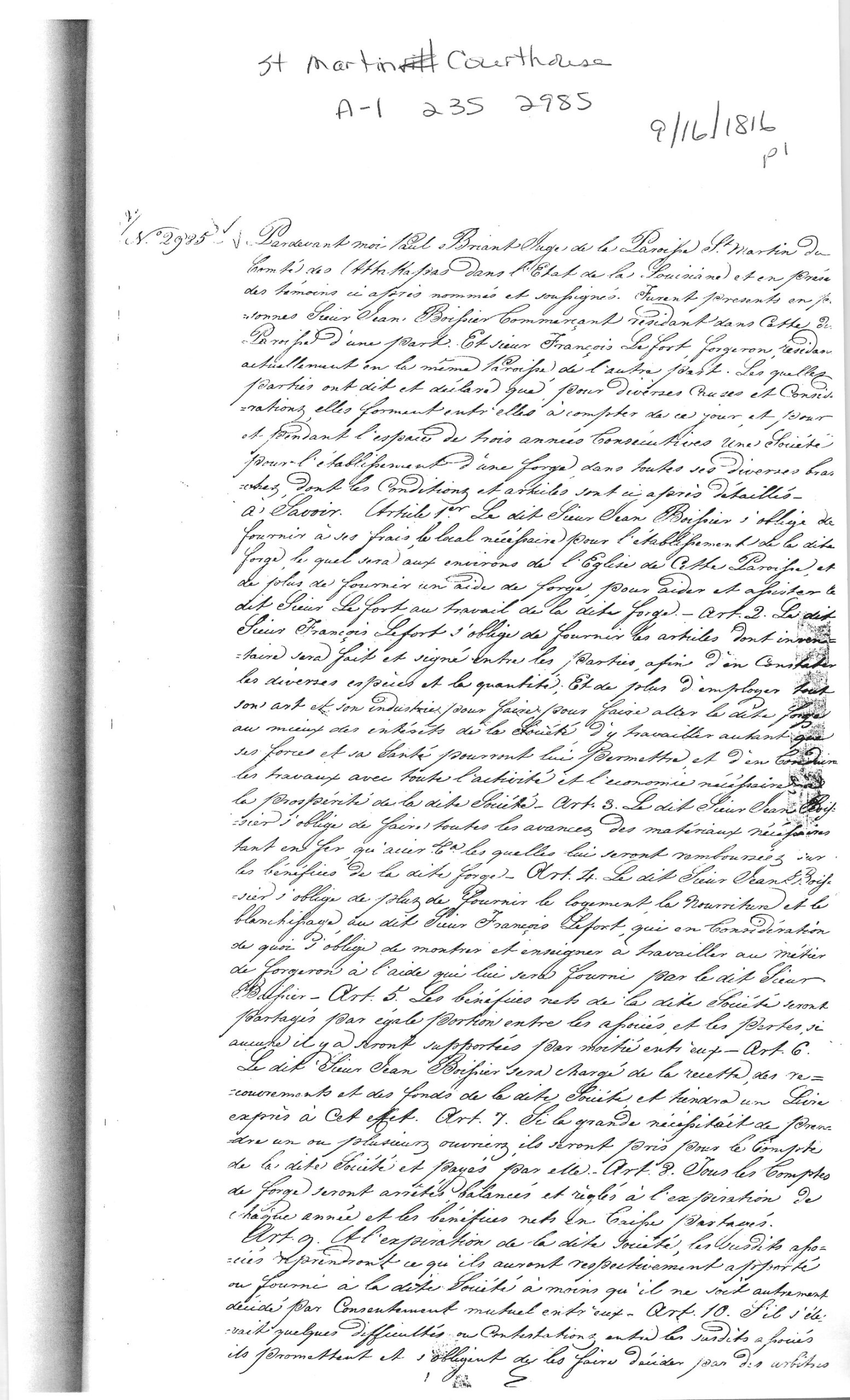
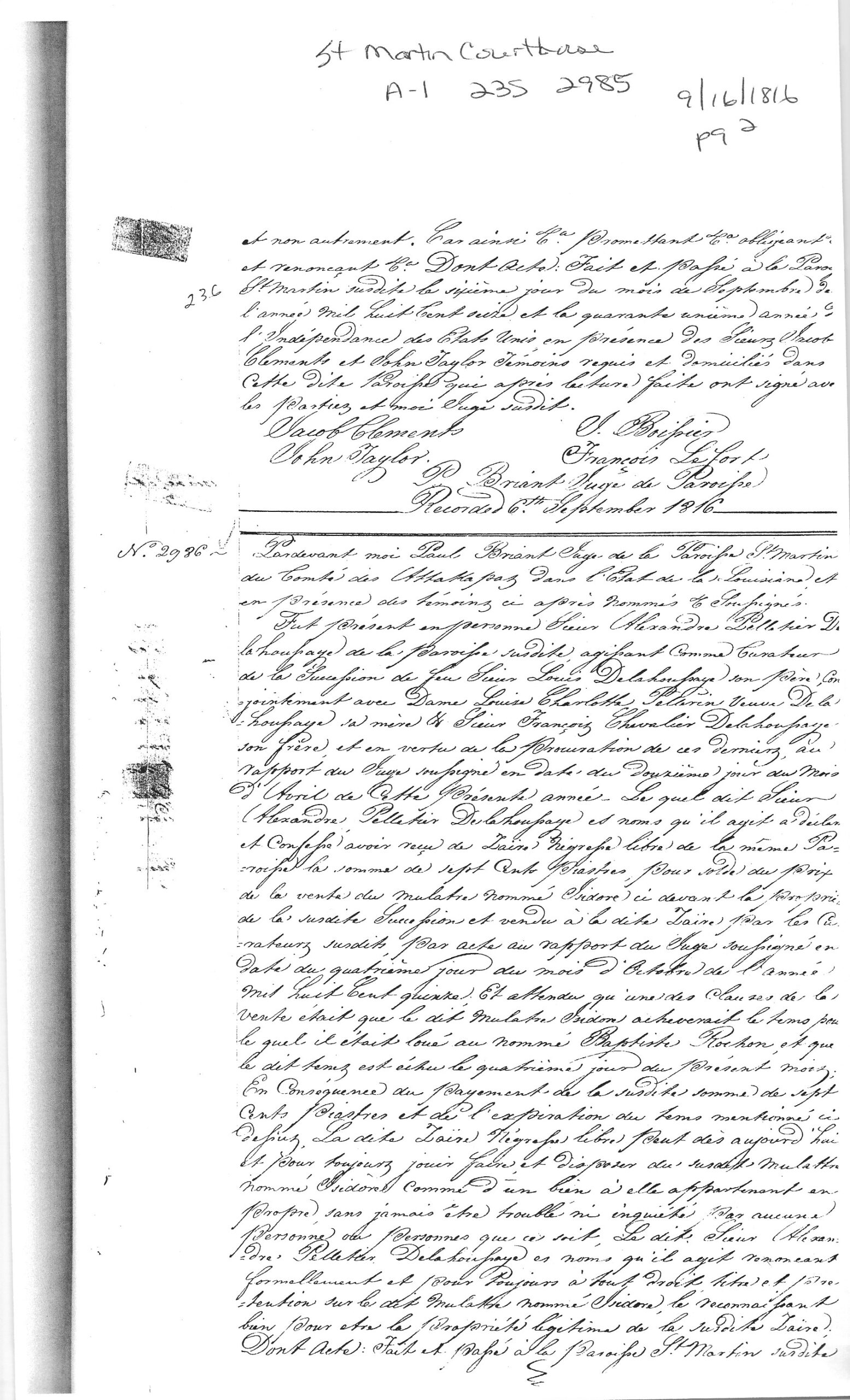
A document dated September 16, 1816 (page 1 and page 2), identifies a François LeFort as a forgeron, or blacksmith, residing in St. Martin Parish. The agreement concerns a forge.
An AI Overiview of the Document:
François LeFort — September 16, 1816
A record dated September 16, 1816, in St. Martin Parish, Louisiana, identifies François LeFort as a forgeron, or blacksmith. The document is a formal agreement concerning the operation of a forge.
The agreement was made before Paul Briant, Judge of the Parish of St. Martin. François LeFort agreed to contribute his labor and skill as a blacksmith to the enterprise. The agreement sets out the responsibilities of the parties for providing the forge, tools and materials needed for the work, and establishes how the business was to be operated.
Among its provisions, the agreement addresses the furnishing of materials necessary for the forge, François’s obligation to work “au métier de forgeron”—at the trade of blacksmith—the payment of expenses, the hiring of additional workers if necessary, the keeping and settlement of accounts, and the division of the net profits of the enterprise. It also provides a method for resolving disagreements between the parties.
The document was executed at St. Martin Parish on September 16, 1816, and the name François Lefort appears among the signatures.
Translation of the important portions
Rather than reproducing all of the legal language, these are the portions most useful for identifying François:
“Sieur François Lefort, forgeron”
Mr. François LeFort, blacksmith.
“Le dit Sieur François Lefort s’oblige…”
The said Mr. François LeFort obligates himself…
“…au métier de forgeron…”
…at the trade of blacksmith…
The remainder of the agreement lays out the terms under which the forge was to operate: the contributions and responsibilities of the parties, necessary materials and equipment, François’s labor, expenses, additional workers when needed, accounts, profits, and resolution of disputes.
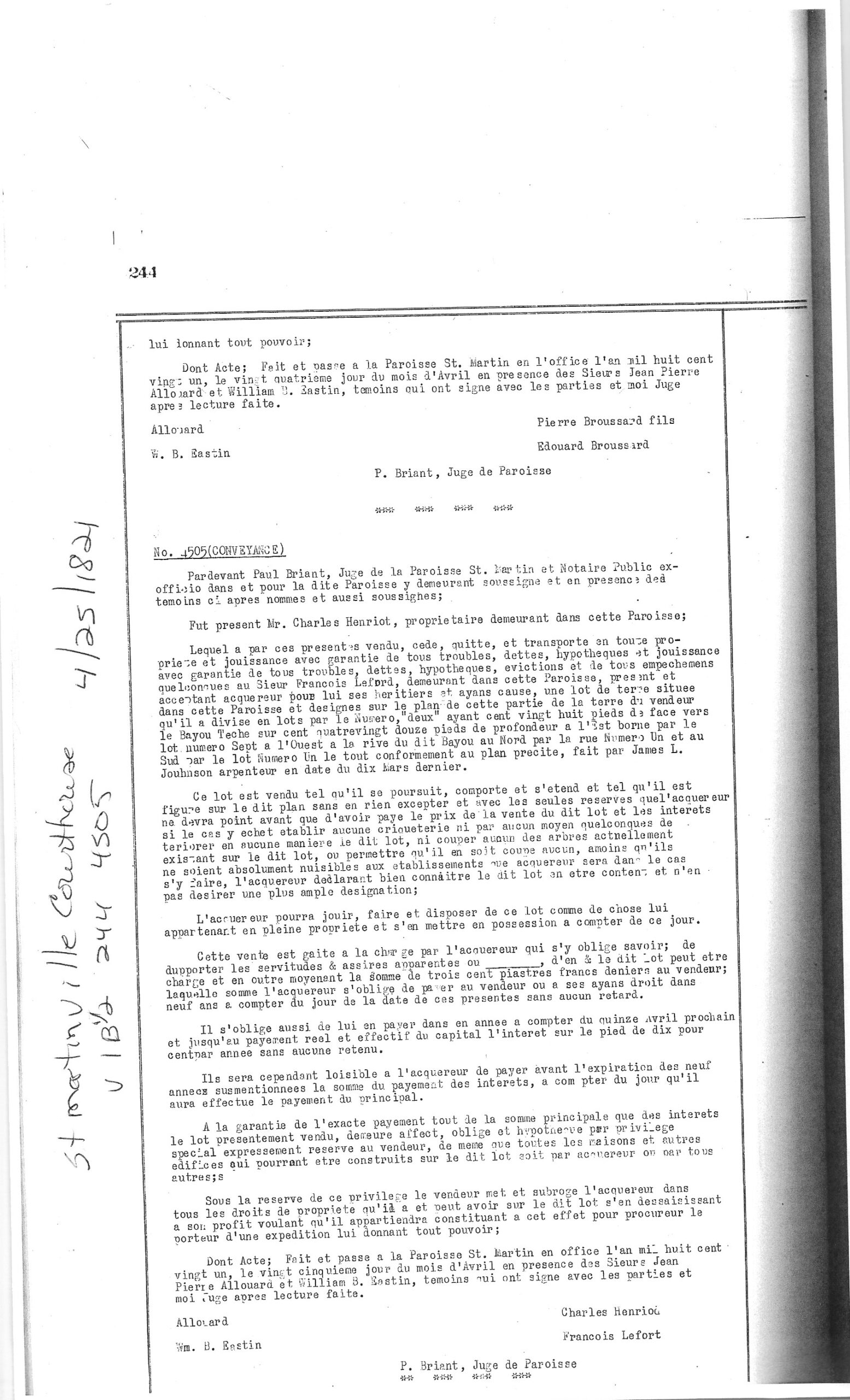
Another document dated April 25, 1821, concerns a François LeFort residing in St. Martin Parish and property on Bayou Teche. The document also contains François LeFort’s signature.
An AI Overiview of the Document:
A François LeFort in St. Martin Parish — April 25, 1821
A second record places a François LeFort in St. Martin Parish on April 25, 1821. Before Paul Briant, Judge of the Parish of St. Martin and ex officio Notary Public, Charles Henriot sold François LeFort a parcel of land in the parish.
The document describes François as “demeurant dans cette Paroisse”—residing in this parish. The property, designated Lot No. 1, had 128 feet of frontage on Bayou Teche and was described according to a survey made by James L. Johnson on March 10, 1821.
The purchase price was 300 piastres. The amount remained due to Charles Henriot under payment terms set out in the act, with interest at ten percent per year. The property remained mortgaged as security for payment of the principal and interest.
The act was passed in St. Martin Parish in the presence of Jean Pierre Allouard and William B. Eastin as witnesses. The names of Charles Henriot, François Lefort and P. Briant appear at the conclusion of the recorded act.
As with the 1816 record, I have not established that this François LeFort was my ancestor. However, the record documents a man of that name residing in St. Martin Parish only three years before the birth of the eldest known child of François LeFort and Julie Landry.
The dates and location make this man a reasonable possibility. If François was about fifty when he died in 1836, he would have been about thirty in 1816 and thirty-five in 1821.
But that is not enough to establish identity.
There were several men named François LeFort in south Louisiana during this period, and I have not found anything in the 1816 or 1821 documents that connects that François directly to Julie Landry/Hébert or their children.
For now, I consider these records possible records of François, but not proven to belong to him. I therefore have not added “blacksmith” or the Bayou Teche property to his history as established facts.
Their Daughter Julie LeFort
Julie LeFort, the eldest known child of François and Julie, was born July 26, 1824. She was about nine when her mother died and twelve when her father died.
A Lafayette Parish record dated August 9, 1841, concerns a marriage license for Julie LeFort, daughter of the deceased François LeFort, and Benjamin Weed, son of Benjamin Weed Sr.
Benjamin Weed is not a stranger who first appears with the 1841 marriage license. His name appears several times in François LeFort’s succession, establishing an earlier connection with the LeFort estate or family.
I have not found a marriage record or divorce record for Benjamin and Julie. By 1845 or earlier, Benjamin was married to Rebecca Williams. What happened between Benjamin and Julie is not known.
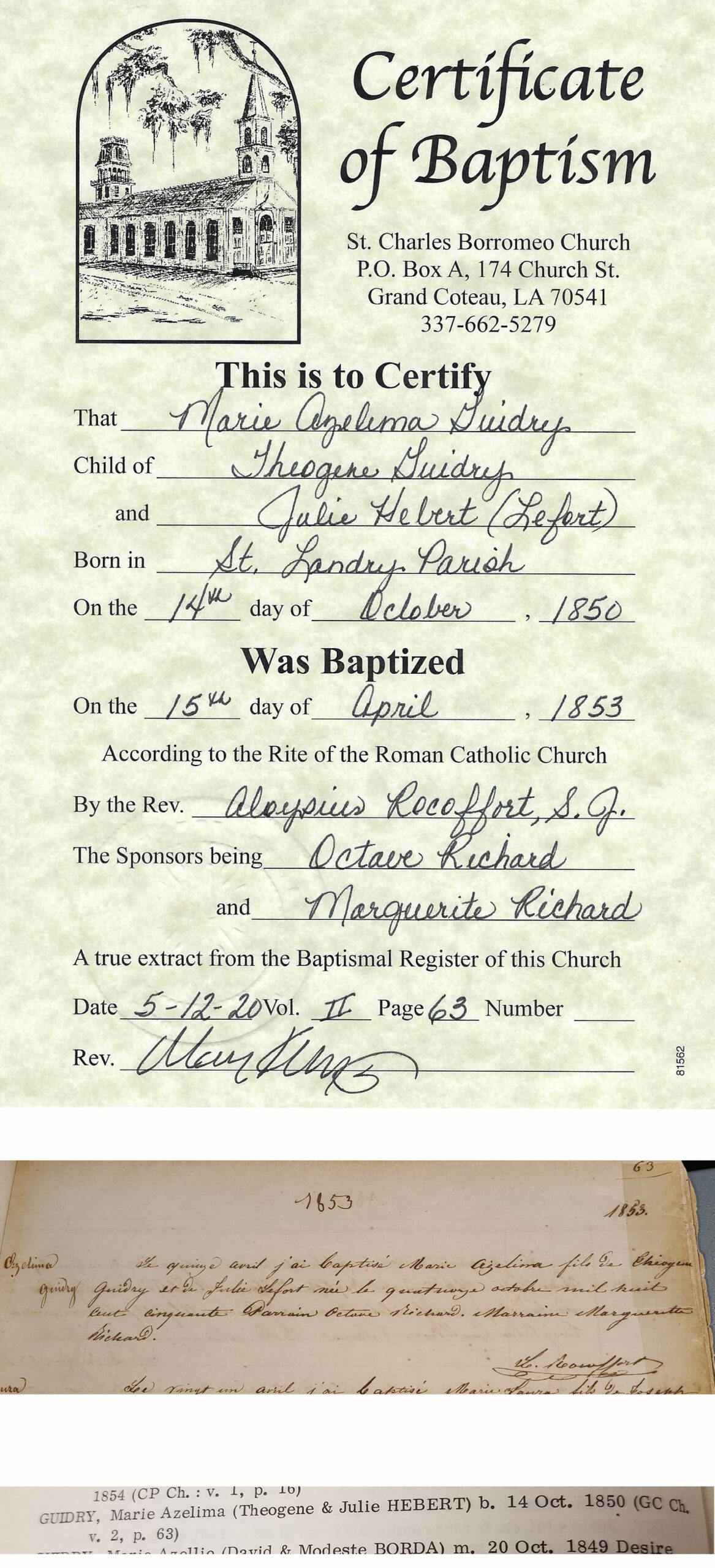
Julie’s only known child, Marie Azelima Guidry, was born October 14, 1850, the daughter of Théogène Guidry and Julie LeFort. Zelima was baptized at St. Charles Borromeo Church in Grand Coteau on April 15, 1853. Her baptismal sponsors included Octave Richard, husband of Julie’s sister Virginie.
There is an important error in the published SWLAR abstract of this baptism. SWLAR gives the entry as:
GUIDRY, Marie Azelima (Theogene & Julie HEBERT), b. 14 Oct. 1850 (GC Ch.: v. 2, p. 63).
The name HEBERT is a transcription error.
I personally examined and photographed the original baptismal register at St. Charles Borromeo Church in Grand Coteau. The original entry clearly identifies Zelima’s parents as Théogène Guidry and Julie Lefort.
A certificate later prepared by the church unfortunately carried the error forward by identifying Zelima’s mother as “Julie Hebert (Lefort).” The original church register does not say Hebert. It says Lefort.
Zelima’s later marriage record provides additional confirmation. SWLAR records:
GUIDRY, Zelima (Theogene & Julie LEFORT) m. 14 May 1866 Alphonse DOMINGUE (CP Ch.: v. 1, p. 33).
A civil marriage license record is also dated April 30, 1866 (Opel. Ct. Hse.: Mar. #2954).
The two SWLAR entries are therefore inconsistent with one another. The baptism abstract calls Zelima’s mother Julie HEBERT, while the marriage abstract correctly calls her Julie LEFORT. More importantly, the original baptismal register itself says Julie Lefort. The 1853 SWLAR entry therefore should not be considered another record identifying someone in this family as Hébert.
Théogène Guidry died November 3, 1857.
By 1860, Zelima was living with her maternal aunt Virginie LeFort Richard and Virginie’s husband, Octave Richard. Octave’s presence as Zelima’s baptismal sponsor in 1853 provides an earlier documented connection between Zelima and her aunt’s family.
I have found no record of Julie LeFort after Zelima’s birth. It is possible that she died sometime before 1860, but I have found no death or burial record to establish that.
What became of Julie remains unknown.
Virginie LeFort
Virginie LeFort married Octave Richard on November 30, 1846. As noted earlier, her SWLAR marriage entry calls her Eugenie and identifies her parents as François LeFort and Julie Landry.
Virginie and Octave had eight known children.
Virginie died only six days after the birth of their eighth child, my great-grandmother, Marie Lucia Richard.
More about Virginie, Octave and their family can be found in my article about Octave Richard.
Joseph LeFort
François and Julie’s son Joseph LeFort eventually left Louisiana for Texas.
According to his descendants, Joseph traveled to Texas by way of the Opelousas Cattle Trail sometime in the 1840s.
Joseph eventually lived in the Liberty and Chambers County areas of Texas.
In Texas records, his surname appears in several forms, including LaFour, LaFore, and other variations. The French pronunciation of LeFort sounds much like “La Four,” making these spellings understandable as the name moved into English-language records.
The surname variation is not the only evidence connecting the Texas Joseph to the Louisiana family. Documentary and family evidence support the identification, and I also have DNA matches with descendants of Joseph, providing additional support that the Texas LaFour/LaFore family descends from François and Julie’s son.
Joseph married Martha Barrow, remained in Texas, and had a large family, with descendants spanning many generations. He died on February 13, 1900.
Questions That Remain
There are still parts of this family’s story I cannot answer.
I do not know who Julie Landry’s biological father was. I do not know why she was identified as Julie Hébert in the baptismal records of her children or whether she herself ever used that surname. I have not found a marriage record for Julie and François.
I have not yet found the evidence that connects François LeFort in Louisiana to one particular François LeFort and family in France. I also cannot yet establish that the François LeFort found in the 1816 and 1821 St. Martin Parish documents was this François.
And I do not know what became of their daughter Julie after 1850.
Those are not blanks I want to fill with assumptions. They are simply places where, at least for now, the records stop.
Research Note
The information in this article is based on records I have found and examined, including church baptism, marriage and death records; civil marriage and succession records; census records; and published abstracts in Southwest Louisiana Records (SWLAR). Where original records were available to me, I compared them with the published abstracts.
As the baptismal record of Marie Azelima Guidry demonstrates, errors can occur in published transcriptions. When an abstract and an original record differ, I have relied on the original record and noted the discrepancy in the article.
The information presented here reflects the records I have located as of August 2026.