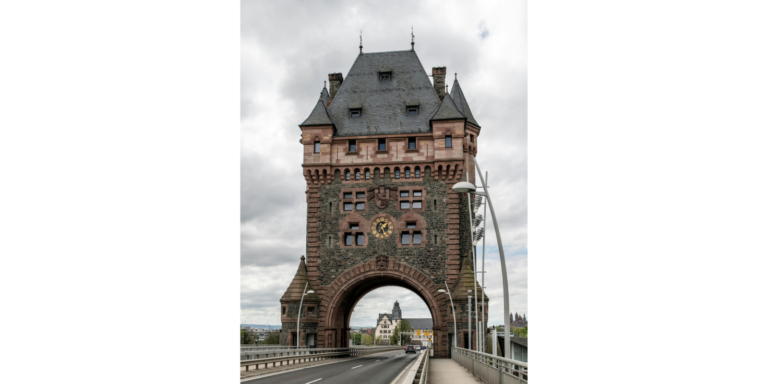

Worms, Germany, 1945
Restoring the identity of PFC Charles Theodore Plog in two wartime photographs from Worms, Germany.
For more than eighty years, the fallen American soldier depicted in two World War II photographs from the Nibelungen Bridge in Worms, Germany, remained unidentified in those images, remembered simply as “the fallen soldier on the bridge.”
His body appeared in two wartime photographs taken during the closing months of World War II. One image was captured by a U.S. Army Signal Corps photographer, the other by the Associated Press. Historians studied them. Veterans remembered them. Researchers searched for clues. Yet the identity of the young American soldier lying on the bridge was never connected to the photographs themselves.
Through careful research and the patient examination of military records, battlefield reports, and archival evidence, the soldier depicted in those photographs has been identified as Private First Class Charles Theodore Plog of Company A, 10th Armored Infantry Battalion, 4th Armored Division.
The historic wartime photographs associated with this story are an important part of the historical record, but some readers may find them disturbing. Rather than reproduce them here, I invite readers to explore the original investigation into the identification of PFC Charles T. Plog.
For me, the identification carries a personal significance. I was privileged to participate in the research and reporting that helped restore PFC Charles Theodore Plog’s identity in those wartime photographs after more than eighty years. Watching an anonymous fallen soldier in two historic images become a man with a name and a story reinforced a simple truth: history is made up of individuals whose lives deserve to be remembered.
The identification itself is remarkable, but what lingers with me is something deeper than solving a historical mystery.
History has a curious way of preserving great events while obscuring the individuals who lived them. We remember the campaigns and the commanders, the victories and the losses. We preserve photographs and official reports. Yet the people captured in those moments can become anonymous, their stories separated from the images that preserve them.
For decades, the soldier on the bridge was one of those anonymous figures.
The photographs taken at Worms, Germany, documented a moment in the final weeks of a war that had consumed much of the world. They captured the cost of combat with an honesty that words often fail to convey. Yet the fallen American soldier depicted in those photographs remained unidentified. The photographs could not tell us who he was, where he came from, or who waited for him at home. They could not tell us that the fallen soldier depicted in those photographs had a name: Charles Theodore Plog.
There is something profoundly human about reconnecting a name with a face and a moment in history. Genealogists understand this feeling. Historians encounter it from time to time. Families who discover an ancestor’s story know it well. A person who had become an anonymous figure in a photograph is once again connected to his name.
A name changes everything.
The fallen soldier on the Nibelungen Bridge was not simply part of a famous wartime photograph. He was a son of Poughkeepsie, New York. He was a brother. He was a friend. He was a son. He was a brother. He was a friend. He was an American soldier serving with the 4th Armored Division as Allied forces pushed deeper into Germany during the final months of the war. He was a young man whose life ended far from home and whose identity in those photographs remained unknown for generations.
For more than eight decades, the photographs circulated without the identity of the fallen soldier attached to them.
That may be one of history’s quiet tragedies. Images endure. Headlines fade. Witnesses pass away. Sometimes the stories behind a photograph become separated from the people who lived them.
Yet every so often, someone asks a question: Who was he?
That simple question can send researchers through military records, newspaper archives, battlefield maps, casualty lists, and forgotten documents. Sometimes, it also reminds us that history is a collaborative endeavor, built by people willing to follow the evidence wherever it leads and to share what they find.
Perhaps that is why this story resonates so deeply.
The identification of Charles Theodore Plog does not change the outcome of the war. It does not alter the history of the Nibelungen Bridge in Worms, Germany, or the Allied advance into Germany during the final months of the conflict. It does something quieter, and perhaps more enduring.
It restores a connection between a man and a moment in history.
For more than eighty years, the fallen American soldier depicted in two World War II photographs from the Nibelungen Bridge in Worms, Germany, remained unidentified in those images. Now, the identity of the soldier in those photographs has been restored.
Private First Class Charles Theodore Plog.