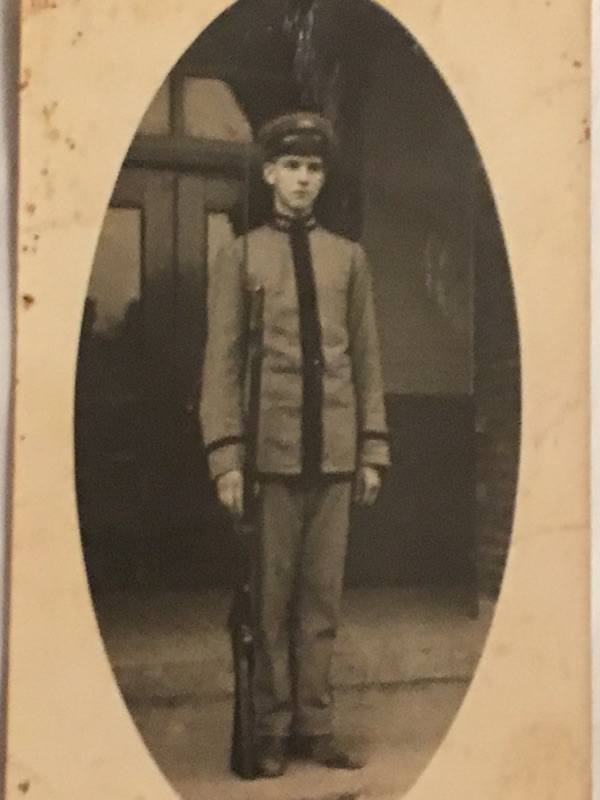
Several years ago, my husband and I went to one of my dad’s cousin’s house to visit and to go through old photos. She gave me some of the photos, and I took photos of some of the others.
The above photo of what appears to be a Louisiana State University (LSU) cadet from the 1910s was one of the photos that I took a photo of, and I also took a photo of the back of the photo.
There was no name to identify the cadet, except for initials – W.C.F. The photo was sent to my great-grandfather, Joseph Cleo (JC) Lagrange. The cadet misspelled the name as Legrange. Unfortunately, I didn’t realize that I didn’t capture the complete back of the photo card when I took a photo of it, which left off the box number in the address.
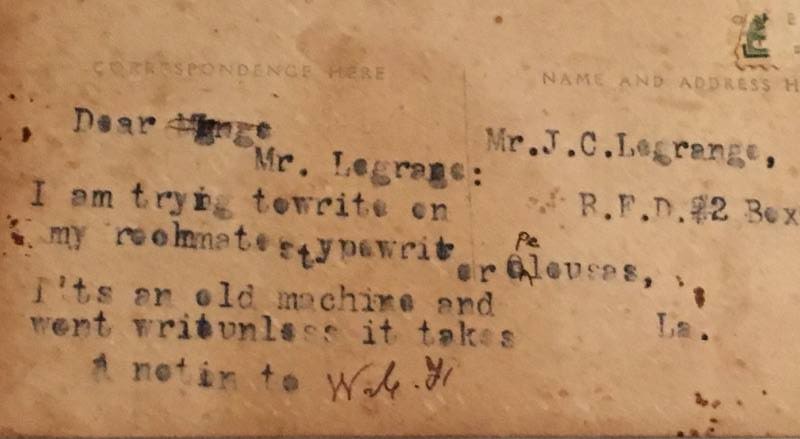
Dear Mr. Legrage: I am trying to write on my roommate’s typewriter. It’s an old machine and won’t write unless it takes a notion to. W.C.F. Mr. J.C. Legrange, R.F.D. 2 Box ??, Opelousas, La.
Dad’s cousin had no clue as to who the cadet was, and neither did my dad. I tried looking at a group photo of cadets that I found online. I tried to find cadets’ names whose last names started with F.
After a while, I realized the cadet was probably not a family member since he addressed the photo card as Mr. Legrange. Maybe the cadet was a friend of my family, or maybe a neighbor. My next step was to check the 1910 United States Census for my great-grandfather.
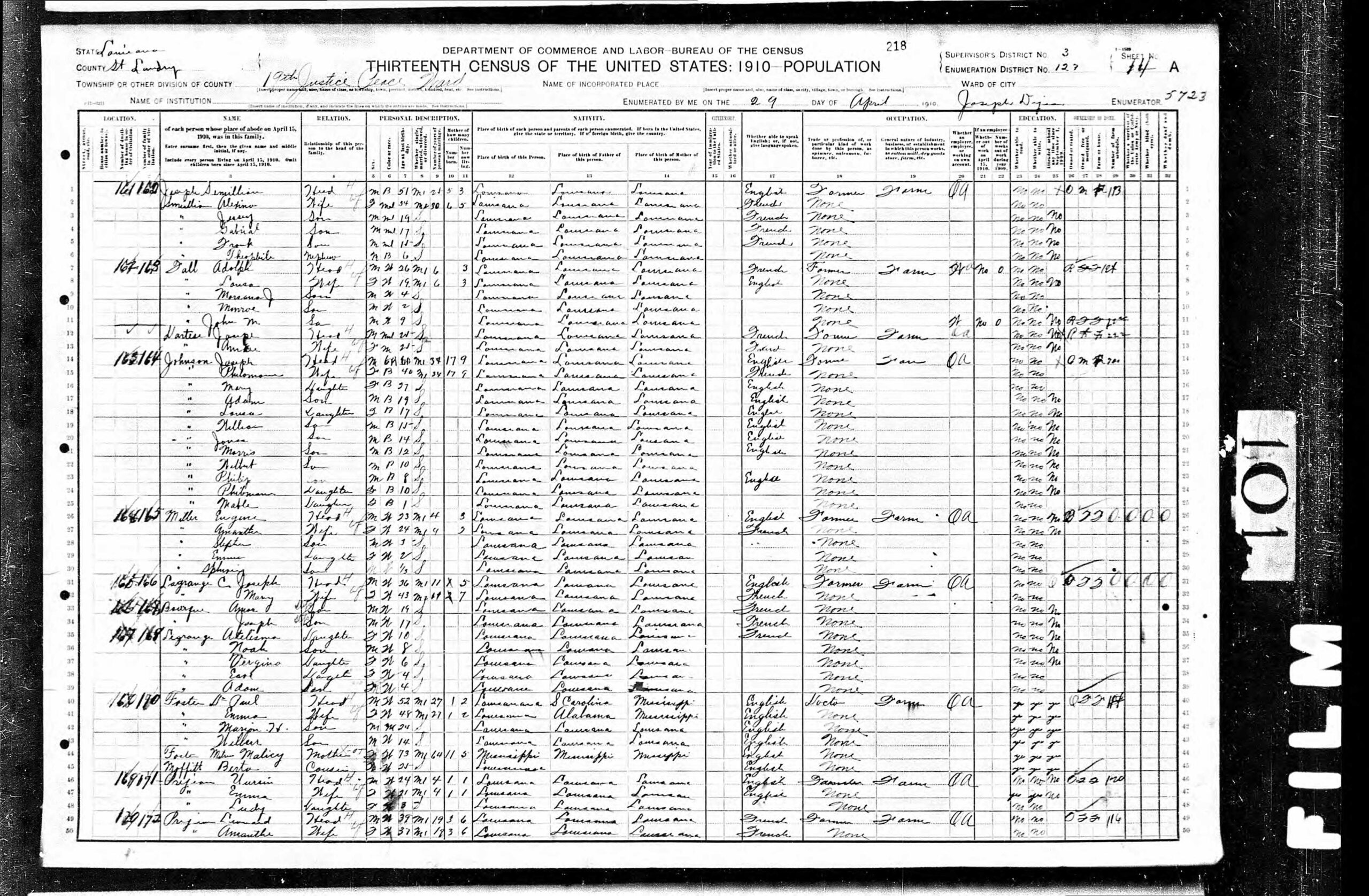
In the 1910 census, after my great-grandfather and family, was a family named Foster, the Dr. Paul Foster family. His wife’s was Emma (Daniel) Foster, and their sons were Dr. Marion H. (Hope) Foster and Wilbur (Carradine) Foster.
When I saw Wilbur’s name, I figured he was likely the cadet in the photo. I searched Ancestry.com and found his middle name, Carradine, and his birthdate of October 18, 1894, born in Plaquemine Ridge (sometimes called Plaquemine Point), near Lawtell, Louisiana.
I do not have any dates for his LSU attendance; however, I would suspect it may have been between 1910-1917.
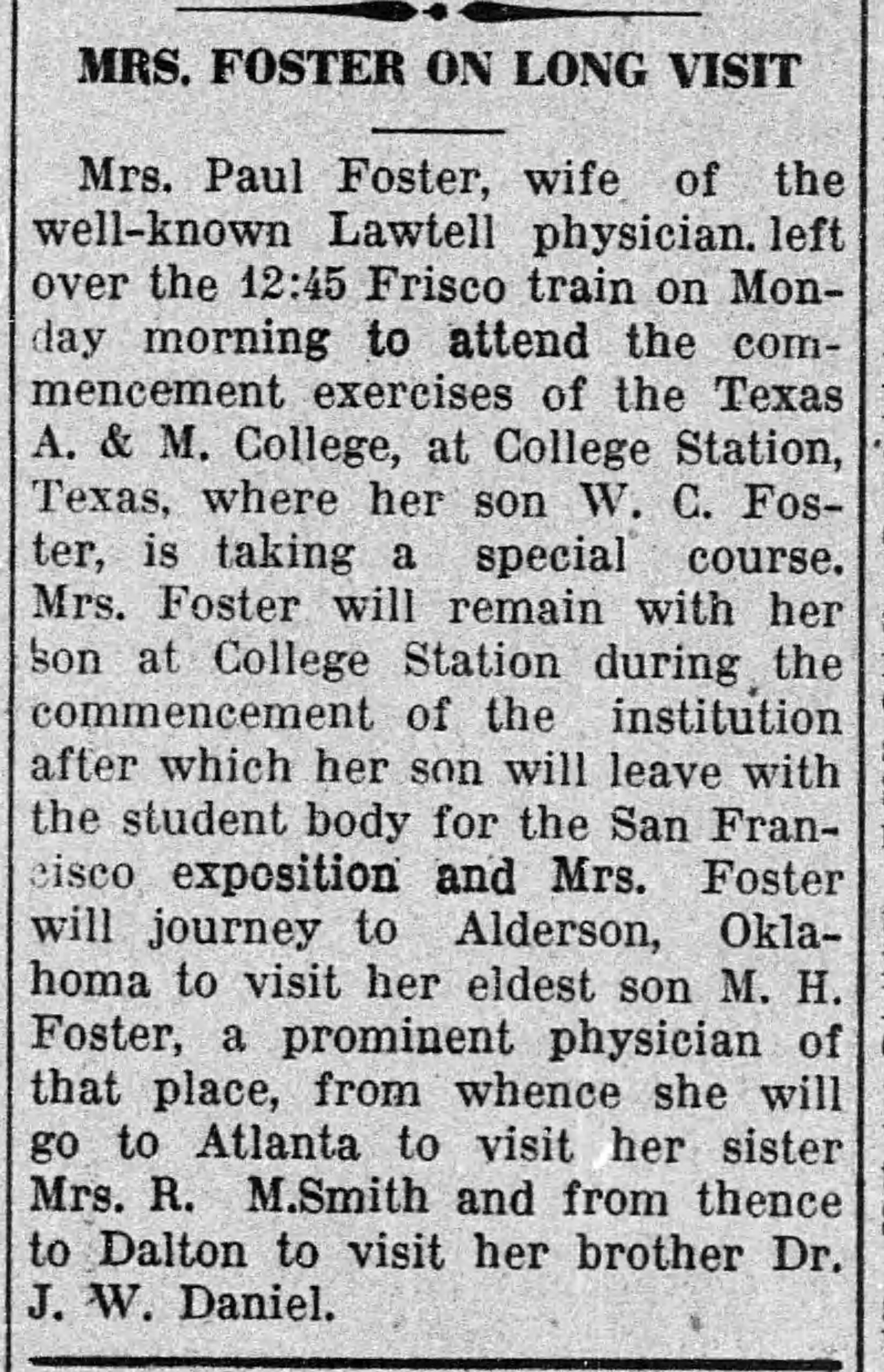
MRS. FOSTER ON LONG VISIT – Mrs. Paul Foster, wife of the well-known Lawtell physician, left over the 12:45 Frisco train on Monday morning to attend the commencement exercises of the Texas A. & M. College, at College Station, Texas, where her son W. C. Foster, is taking a special course. Mrs. Foster will remain with her son at College Station during the commencement of the institution after which her son will leave with the student body for the San Francisco exposition and Mrs. Foster will journey to Alderson, Oklahoma to visit her eldest son M. H. Foster, a prominent physician of that place, from whence she will go to Atlanta to visit her sister Mrs. R. M. Smith and from thence to Dalton to visit her brother Dr. J. W. Daniel. – St Landry Clarion, Opelousas, Louisiana, June 15, 1915
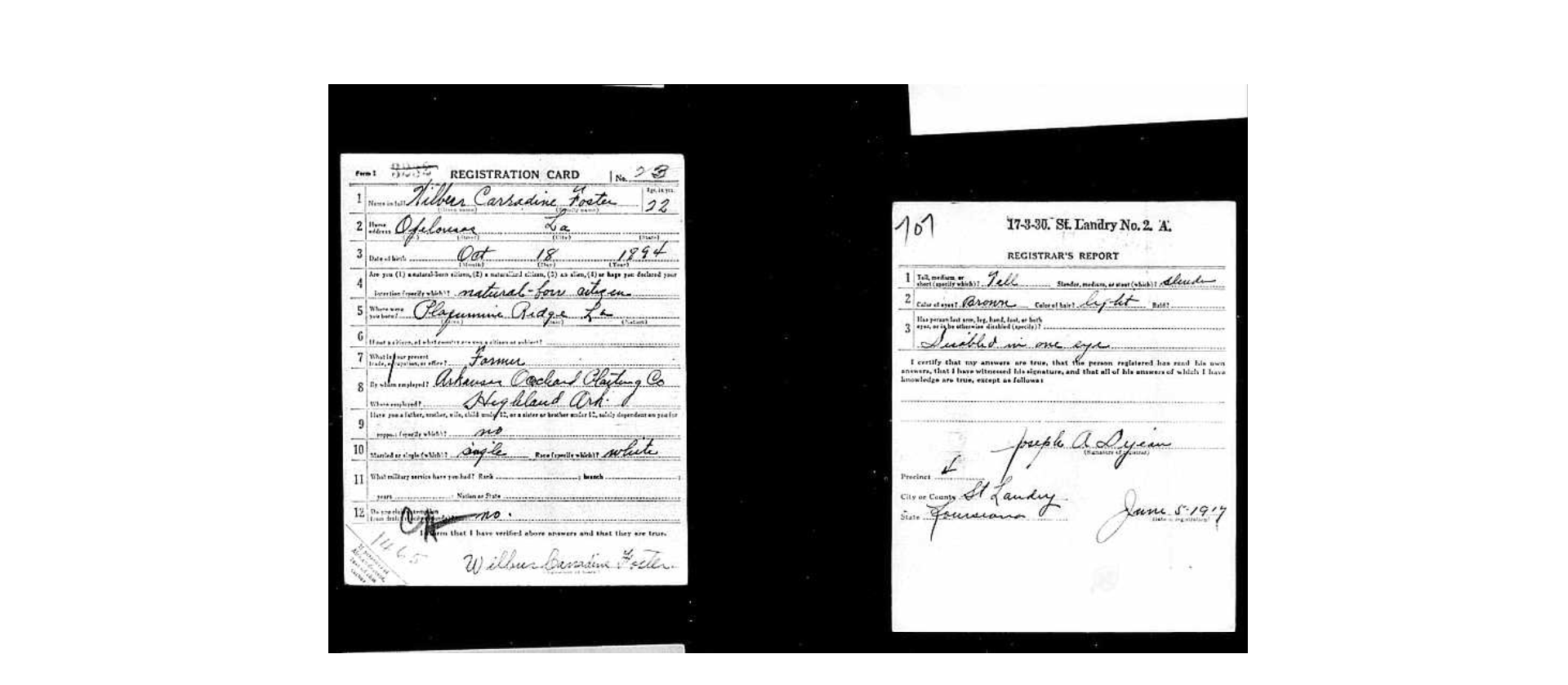
Wilbur registered for the military on June 5, 1917, the same day his neighbor, my half great-uncle Amos Bourque, registered. The registration card shows he was born October 18, 1894, and was a farmer for Arkansas Orchard Planting. He was tall, with brown eyes and light hair color. It states he was disabled in one eye.
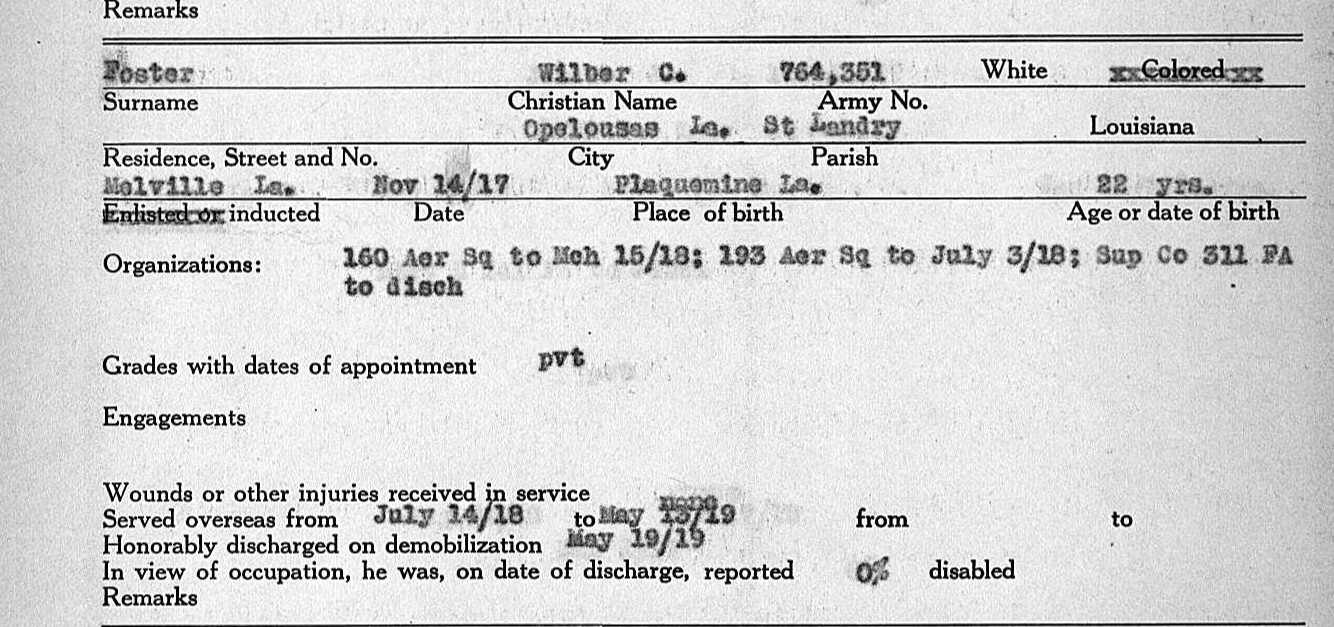
Both Wilbur and Amos went into the United States Army on November 14, 1917, at Melville, Louisiana. His organization was 160 Aer Sq to Mch 15/18; 19e Aer Sq to July 3/18, Sup Co 311 FA to discharge. In view of occupation, he was, on the date of discharge, reported 0% disabled. It shows he was born in Plaquemine, Louisiana; however, Plaquemine is a city near Baton Rouge. He was born in Plaquemine Ridge (or sometimes referred to as Plaquemine Point), near Lawtell, St. Landry Parish, Louisiana.

From the St Landry Clarion in Opelousas, September 7, 1918 – a letter from Wilbur to his mother.
(This is not a “letter from France,” but one “from England.” It is from Wilbur C. Foster, son of Dr. and Mrs. Paul Foster of Route 5 out of Opelousas. Young Foster has been in the service for some time and is no doubt on his way to the front.)
England, August 1, 1918.
Dear Mother:
At last we are “over there,” and as usual with a country that a person has never seen before, England is entirely different from the conception that I had of it. Whatever England may be suffering from the ravages of war, it is not apparent on the surface. Every where we were greeted with smiles and waves and songs. There is not much sign of war weariness, and the financial sign of the industrial changes brought about by the war is the great number of women that are employed at manual labor in the various industries. Quite a few men who are apparently physically fit are scattered over the country yet. We made the voyage without any mishap to any of our convoy.
This is a very beautiful country, and every foot of ground is fully utilized. The whole country seems like one town all over. The largest farms as a rule do not seem to be more than thirty or forty acres, and every farm is divided off by well kept hedges, and there are small flower gardens everywhere. All the houses are made of stone or brick, and are about the same size, and built by the same plans. This is especially true in the cities, where the dwellings are built in long rows, usually one, never over two, stories in height.
The cities are compactly built, and vacant lots are hard to find. The railroads are a joke. The engines are little fellows, with no cowcatchers and no bells or headlights. They have only the smokestack and whistle. The freight cars are about one-third the size of ours, and the passenger cars have no doors in the ends, but are divided up into a number of compartments for eight passengers, with doors opening to the side. The rails are bolted to the ties, instead of being spiked. They certainly do make good time, however.
Everything over here seems to be on a smaller scale than it is in America. When it comes to livestock, this country is far ahead of ours. Notwithstanding the great strain that the war has been in the livestock industry, beautiful horses and fine cattle can still be seen on every hand.
I am going to write every week, but do not worry if you do not always get my letters, because you must remember that most of the ships that the subs sink are those that are returning to America, and some of my letters might get lost on them.
Preserve all the letters that I write from now on as I want them after the war is over.
Lovingly,
WILBUR C. FOSTER.
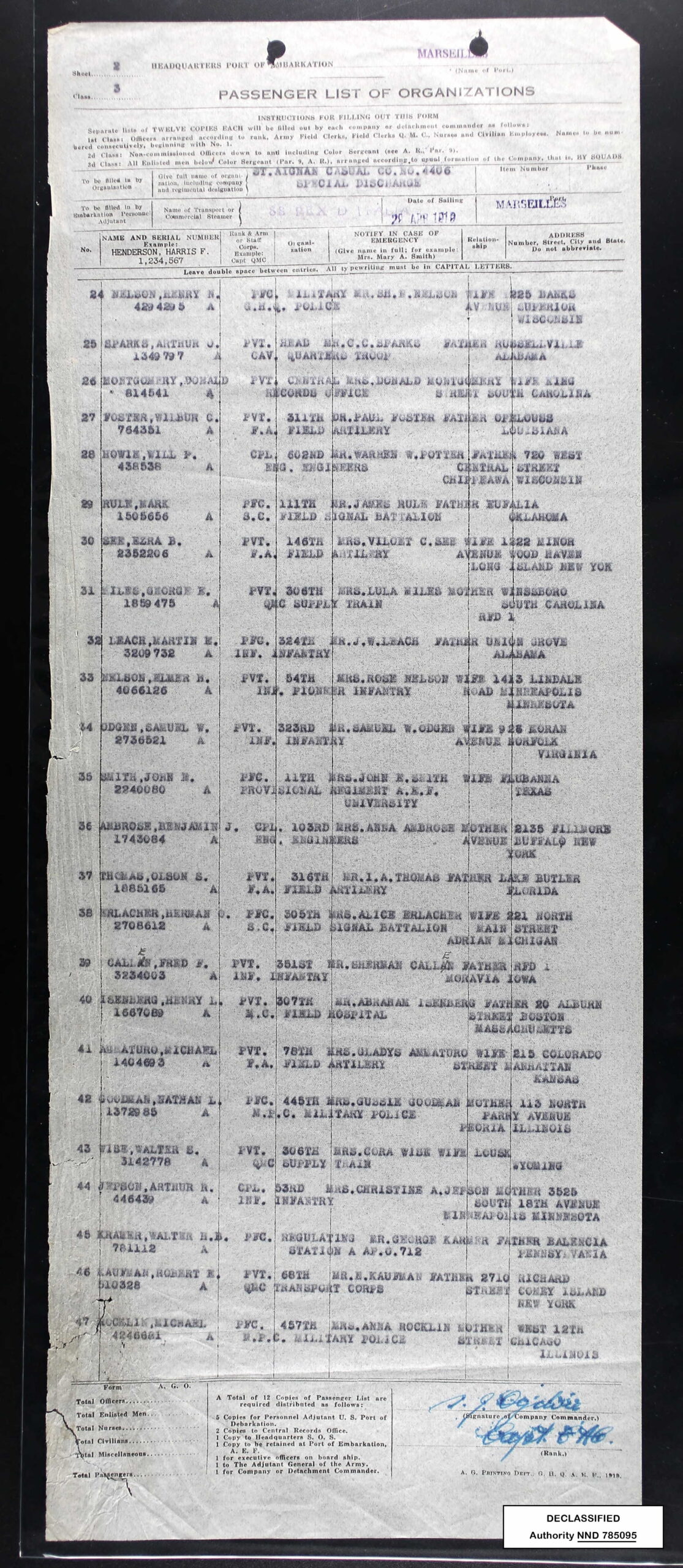
This Passenger List of Organizations from April 28, 1919, shows Private Foster returning home from Marseille, France. He was with the 311th Field Artillery, according to the passenger list. His father, Dr. Paul Foster of Opelousas, Louisiana, is listed as his emergency contact.
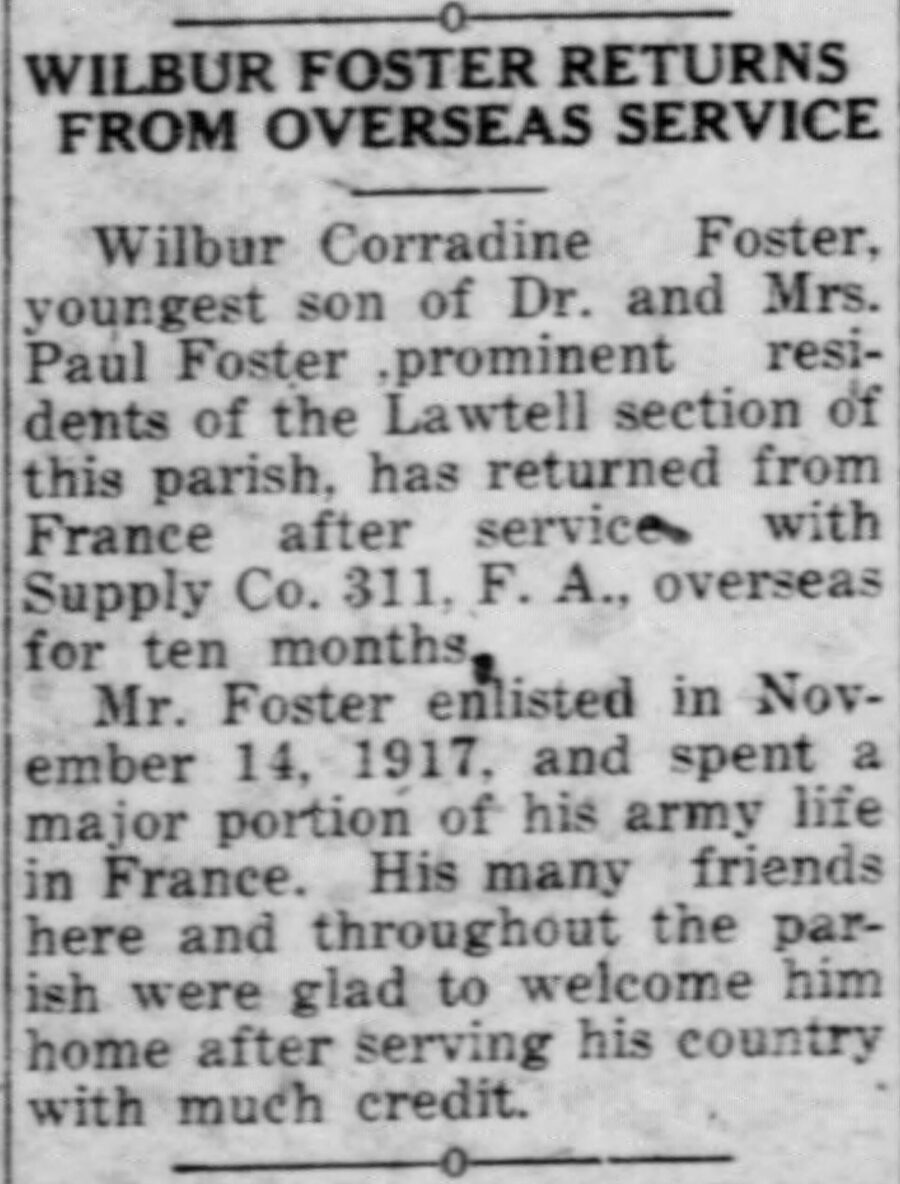
WILBUR FOSTER RETURNS FROM OVERSEAS SERVICE: Wilbur Corradine Foster, youngest son of Dr. and Mrs. Paul Foster, prominent residents of the Lawtell section of this parish, has returned from France after service with Supply Co. 311, F. A. [Field Artillery], overseas for ten months. Mr. Foster enlisted on November 14, 1917, and spent a major portion of his army life in [Marseille], France. His many friends here and throughout the parish were glad to welcome him home after serving his country with much credit. – Clarion News, Opelousas, LA, June 11, 1919.
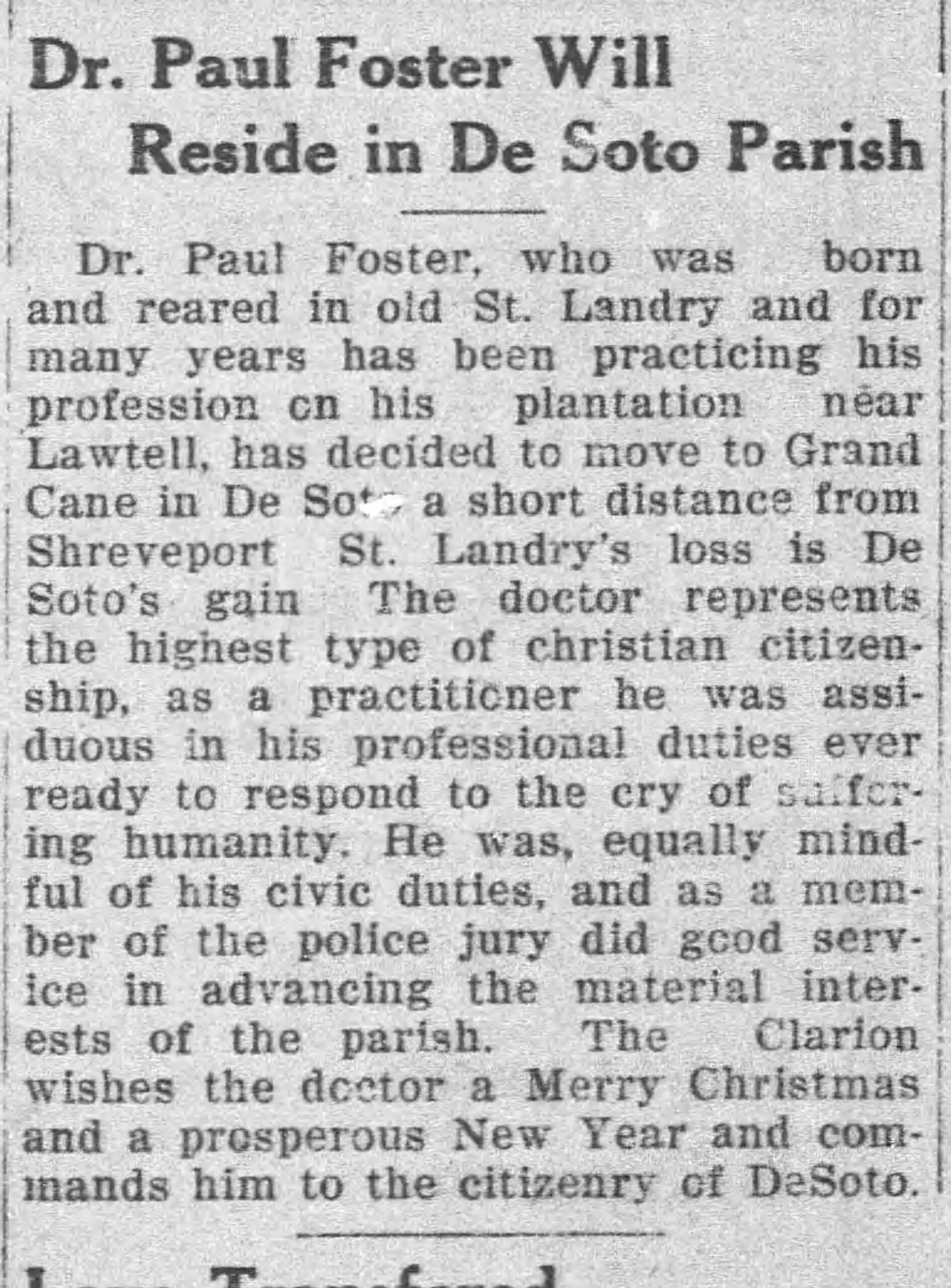
The above article from the St. Landry Clarion on December 27, 1919 regarding Dr. Foster moves to Big Cane in DeSoto Parish.
The 1920 census shows Wilbur was in Big Cane along with his parents.
According to an article on Friday, June 23, 1922, in the Daily Clarion Progress in Opelousas, Louisiana, Wilbur and Mattie Dixon married on June 21, 1922, at her parents’ home in Big Cane. Records show they lived in Big Cane and in Mansfield in DeSoto Parish.
The 1930 and 1940 census, along with his 1942 Military Registration card shows Wilbur working with the Post Office.
The 1950 census shows Wilbur as a retired postman unable to work. They were living on Madison Street in Mansfield.
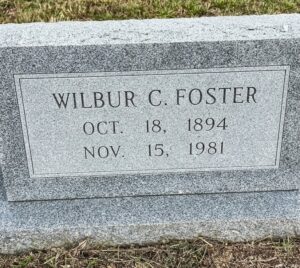
Wilbur passed away on November 15, 1981 and is buried in Mansfield, Louisiana by his wife Mattie, who passed away October 6, 1977.
Some records on Ancestry.com shows his death date as December 15, 1981 with his last residence as Ringgold, Bienville Parish, Louisiana.
Plaquemines Ridge, Plaquemine Ridge, Plaquemine Point are various names for an area near Lawtell, St. Landry Parish, Louisiana.