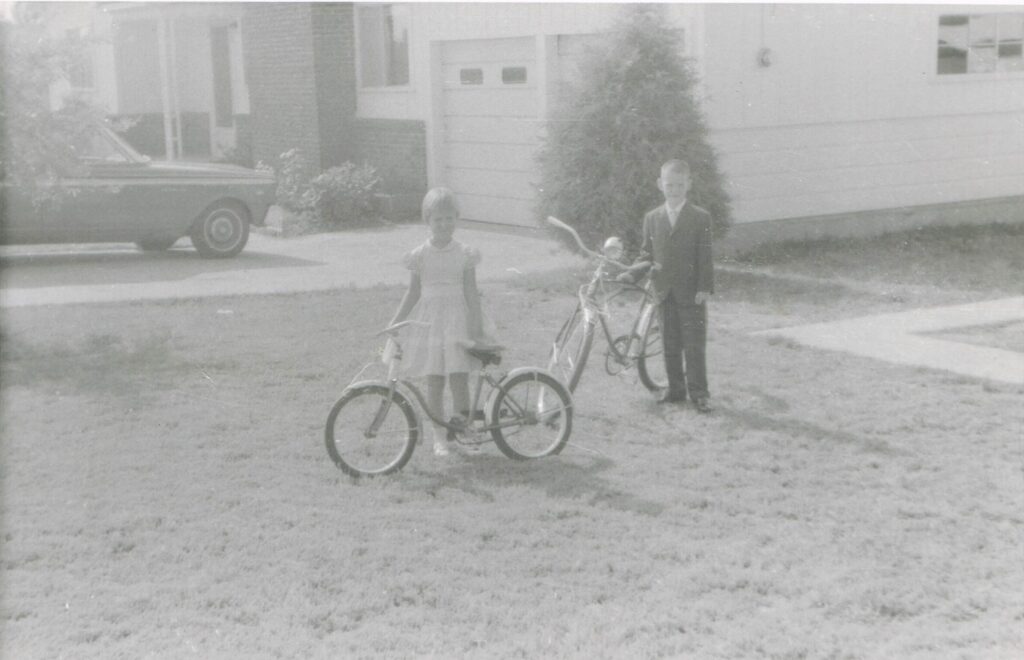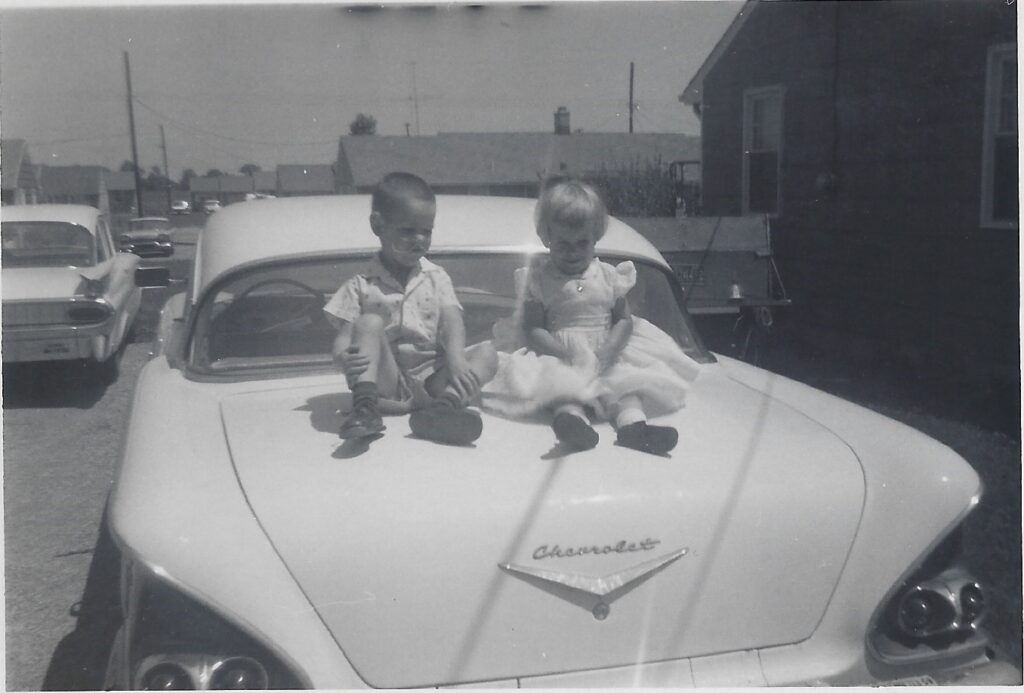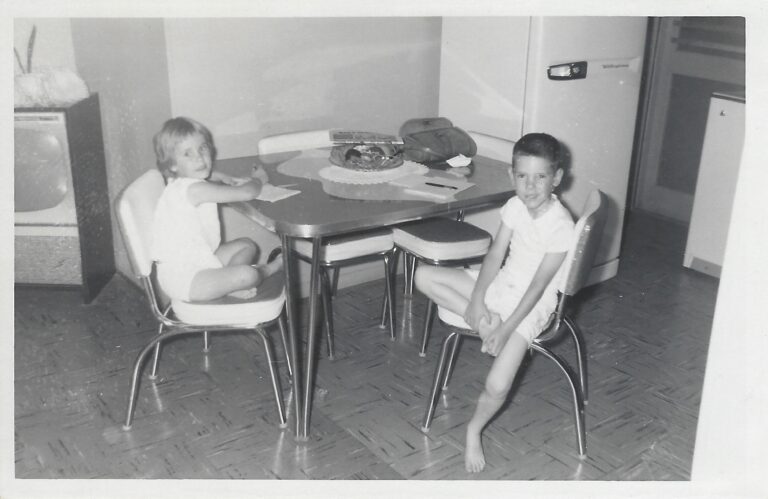

Opelousas, Louisiana, circa 1962
After Dad got orders for his second Army assignment in Korea, we left Highland Park, Illinois, and moved back to our hometown of Opelousas, Louisiana. After we settled into a wooden house on South Street, Dad left for his new assignment.
Mom and Dad purchased a new living room set, coffee, and end tables with a Western motif for our new move before he left for Korea. A photo of the four of us, Mom, Dad, my older brother Glenn, and me, was taken on the sofa before Dad left.
Glenn’s birthday was celebrated before Dad left. My grandparents, great-aunt Evelyn, and her children were there to help celebrate his birthday.
After Dad left, our porch almost caught on fire of something thrown on the porch, and Mom wanted to move to a different house. Our move was just down the street from the house we were living in.
Mom worked downtown at J.W. Low’s, a 5 and Dollar store. My maternal grandmother, Louise, whom we called Momo, cared for Glenn and me while Mom worked.
While living in Opelousas, I don’t seem to recall being inside Momo Louise and Papa Emilian’s house, but I recall being on the farm where they lived. Perhaps that is because we were not living with them at this time as we had done the last time we lived in Opelousas.
Momo would sew and make some clothes for me. She seemed to enjoy it more when she took Glenn and me downtown to shop for clothes. I suspect she liked to be downtown with us to show off her grandchildren to others. Papa Emilian would drive us to town, park, and sit in the car to wait for us to finish shopping. Sometimes when we got back to the car, we that Papa Emilian had taken a nap while waiting for us.
I slipped in the bathtub one night, hit my chin, and needed stitches. Back then, doctors made house calls or opened their offices for patients to undergo treatment. Once Mom called Dr. Prather, we headed to his office, and he stitched up my chin.
When I had my tonsils removed, I still remember Mom holding me while I got an injection; I was kicking and crying. I also remember the mask put over my nose and mouth to put me to sleep for the surgical procedure.
A popular song of that time was Big Girls Don’t Cry, which Mom often reminded me of whenever I started to cry, especially when my chin was getting stitched up. But big girls do cry, both as young girls and as older girls, and as women. We cry when we are hurt, upset, or disappointed, and when we are happy with joy from falling in love, having children, and when we lose a loved one.
Mom, and sometimes Momo Louise and Papa Emilian, took us to visit family and friends. They worked hard during the week; it was time for family and friends on weekends. It was always a treat when visitors went to their house, especially if there were children with them, as that meant Glenn and I had others to play with while the grownups visited.
Mom kept a clutter less, neat, clean house. She had plastic doilies that she used on the coffee table, along with a glass bowl and plate set. Today, I have that set. Several years before mom passed away, after asking her how long she had the set, she said she received the bowl and plate as a gift in 1948.
I was in awe of the majorettes twirling their batons during the city’s annual Yambilee Festival. After the parade, we went to the fair, which is the first one I remember going to; it was exciting seeing the rides and lights. Mom endowed us with cotton candy and candy apples while we were at the fair.
During Christmas, Aunt Evelyn and her family visited with us, and Mom took pictures of us by our aluminum Christmas tree.
For the Christmas Parade, we were there with Aunt Evelyn and her children. Her children had tickets for a Santa spaceship ride (it was a bus). I followed Aunt Evelyn’s children on the bus but had no ticket for the ride. Fortunately, Santa’s helper let me stay on the bus as it had already started moving.
When visiting Papa Emilian’s sister, Julia, she had a photo of Mom at about three years of age. It looked like me in the picture, and I kept insisting to Nan Julia that it was me in the photo. It wasn’t until I was much older that I realized it was indeed Mom in that photo, just as Nan Julia said it was.
There was a large ditch in front of Nan Julia’s house with a large pipe across it. It was fun to walk across the pipe to cross the ditch.
I tried spending the night with Nan Julia’s granddaughter but wanted to go home, so Mom had to come to get me. I tried spending the night at another place, and the same thing happened. I guess I was still too young to sleep away from home.
Papa visited his older brother Theodule (Dule) and his family in Leonville, and often took Glenn and me with him. He usually stopped at a small country store along the way to allow Glenn and me to have whatever treat we wanted. Yes, Papa spoiled us just as Momo did.
We must have gone to Uncle Dule’s on Easter Day because I remember being there with my Easter Basket. Mom had gotten a toy sewing machine for me for Christmas or Easter; I had the toy with me during one of our visits to Uncle Dule.
Papa Emilian’s youngest brother, Jules, was a twin with Julia; they were the youngest of ten siblings. Only four survived into adulthood. My memory of visiting Uncle Jules, a farmer raising cotton, during this period was when he and his family lived around Jennings Road outside Opelousas.
Especially due to being an only child, Mom was close to her cousins, considering them siblings instead of cousins. We frequently visited Uncle Jules’ and Nan Julia’s adult children. Uncle Dule did not have children but had two step-children, who we also visited often.
Momo Louise’s parents and most of her eight living siblings resided in Eunice. We made trips to Eunice to visit her family there. Her mother had a stroke several years before and couldn’t walk or talk. I watched one of her daughters brush her lengthy hair, braid it, and cross the braids over her head. I don’t recall Momo’s father speaking English; he only knew Cajun French. Nor do I remember him ever talking to me, perhaps due to his not speaking English.
Momo Louise’s mother died not long before we moved away. Momo wanted me to kiss her mother in the coffin; however, I was scared to kiss her, fearing I would die if I touched a dead person. My fear may have been attributed to there being a mother and her baby in a coffin in the next room. To this day, I have not touched a dead body.
A month before we moved away, Aunt Evelyn had her fifth child. Mom and I visited Aunt Evelyn at the St. Landry Clinic to meet the new baby.
Mom took Glenn and me to have a portrait done. I recall going to a photography studio, I think Mack’s, which I am fairly sure was in the back of the building where Java Square is currently located.
From time to time, we saw my paternal grandmother, Esther, but I do not have many memories of her from that time. I believe she was living in Port Barre.
I vaguely remember visiting Dad’s brother Lawrence and his wife Mavis. Dad’s only sister, Verna, was there with her children. One of my cousins had boxing gloves there, and the boys boxed.
We went to Willie’s Campground in Washington for a cookout with Momo Louise and Papa Emilian. Dad’s youngest brother, Joe, and Aunt Vera were there with their children. It was a day of fun with family and playing outside.
We also were at Willie’s Campground with Momo Louise’s aunt Louisiana and her husband Dovic. I do not recall if this was at the same as we were there with my cousins.
Aunt Louisiana, whom we called Nan Nan, would often bring a candy cake to me when they visited. I recall being at Momo’s when Uncle Dovic and Nan Nan would drive up the shell road, bringing excitement for me not only because of their visit but hoping that Nan Nan would bring a candy cake for me.
My grandparents’ good friend Saul and Glenn’s birthdays were a few days apart; both birthdays were celebrated with a cookout at South City Park. We often spent time with my grandparents while they visited with Saul and his wife, Darlee.
We attended at least two weddings while in Opelousas: one for Mom’s cousins and one for Saul and Darlee’s son.
My paternal grandfather, AC, suffered from mental illness due to working in chemical tanks and/or being hit in the head (as the story goes, he was hit in the head with a butt of a gun and/or kicked in the head by a horse). He was in a state mental hospital most of his adult life. He loved to play checkers, so when we would visit him, Mom would make sure we brought a checker set with us to play checkers with him. His brothers Noah, Adam, and sister Eve were there on one of our trips to visit Papa AC. He was always polite when we saw him. He did know his siblings; however, he did remember things after he got sick. He did not realize that we were his grandchildren or that he had a son (Dad), his only child.
The Cuban Missile Crisis delayed Dad’s return from Korea. Once he returned, it was time for another move for us, to Barling, Arkansas, next to Fort Chaffee, where Dad was re-assigned.