
Worms, Germany, 1969-1970
Living in Worms, Germany, was the best. Pronounced “Voɐms,” the name itself felt different, just like everything else about life there.
Dad was a United States postal inspector stationed at Taukkunen Barracks on the Army post. We lived in a small military housing area called Thomas Jefferson Village. We moved there from Hanau toward the end of my fifth grade year and spent all of my sixth grade at the American Elementary School in Worms.
The school was about three blocks from our third-floor apartment on Wurdtwein Strasse. In each of the three places we lived in Germany, our homes were in long apartment buildings with three floors and three stairwells. The Army post in Worms was small, so the junior high and high school were located at a neighboring post in Mannheim. My older brother, Glenn, rode the bus there each day, while my younger brother, Kevin, attended the same elementary school as I did.
During sixth grade, part of my class went on a ski week at Chiemsee. We had ski lessons for half the day. The other half was supposed to be school, but more often than not, we went sightseeing instead. Skiing was not kind to me, but it was still an adventure.
Chiemsee is a large lake in southern Germany, often called the “Bavarian Sea” because of its size. It sits between Munich and the Alps, surrounded by mountain views that felt almost unreal at the time. In the winter, everything seemed quieter, covered in snow, with a stillness I had never experienced before. It was the kind of place that made you feel small in the best possible way, as if the world was much bigger than anything you had known.
We toured Herrenchiemsee, the castle of King Ludwig II, located on an island in the lake. The castle was modeled after Versailles, grand and elaborate, filled with ornate rooms and long halls that seemed to go on forever. Reaching it required a boat ride across the lake, which made the visit feel even more like stepping into another world. It was my second time visiting, but no less memorable.
Looking back, I did not realize it then, but places like Chiemsee were shaping how I would remember Germany. Not just as where we lived, but as a collection of moments that felt larger than everyday life. Years later, those images still come back, quiet and steady, like the lake itself.
The Army post was about a six-block walk from our apartment. We passed through an old tunnel to get there, and that walk became part of our routine. The post had a chapel, a movie theater, and Dad’s workplace. The first time we went to the theater, the man at the ticket counter recognized Glenn and me. He lived in our building. His name was Curtis, and from then on, he let us into movies for free when he was working. We still had to pay for snacks, which, in hindsight, was probably a good thing.
Glenn and I occasionally babysat for Curtis and his wife, Bertha, and our parents became friends with them. I babysat for other families as well.
By then, I was older, eleven going on twelve, and there was more to do. I attended activities through the American Youth Association. There were baseball, softball, and football games, along with dances, bingo, pinball machines, and pool tables. It was a place to gather, to belong.
The American Youth Association also organized trips. Buses would pick us up to go roller skating in Ramstein, and Glenn and I went often. The bus rides were my favorite part. There was singing, laughter, and a sense of camaraderie that felt effortless. The American Youth Association even hosted a hayride once, which remains one of my favorite memories.
Life in Worms felt full.
My circle of friends included Claudette, Deanna, Dianne, and Jane. Toward the end of our time there, I met Marcia and Petra, who were German and lived next to our housing area. Over the years, I have been able to reconnect with some of them. I found Claudette and Jane again, and more recently, with help from someone in a Worms Facebook group, I was able to reconnect with Petra.
Through those Facebook groups centered around Worms, I have also made new, online friends who share that same connection to the place. The groups have become a way to keep up with what is happening there, both now and in the past. Photos, memories, and stories are shared, and each one feels like a small thread tying me back to a place that never really left me.
In ways I never expected, those connections have brought pieces of that time back to me while also creating something new.
After we left Worms, Dianne sent me a care package filled with gummy bears and other German candy. At the time, gummy bears were not yet common in the United States. That package felt like a small piece of home finding its way back to me.
We had our share of adventures. My friends and I once went to a small German store near our apartment, bought cigarettes, and smoked them behind our building. We explored a nearby creek, visited a sauna room, and spent time downtown. I still remember an older woman warning us about getting “bat wings” on our arms when we got older.
Downtown Worms left a lasting impression on me. The Martin Luther monument stood there, massive and unforgettable. My sense of awe had little to do with who Martin Luther was at the time. It was the scale of the monument, the presence of it, and the feeling of walking among something so large and historic. And, of course, I loved the ice cream.
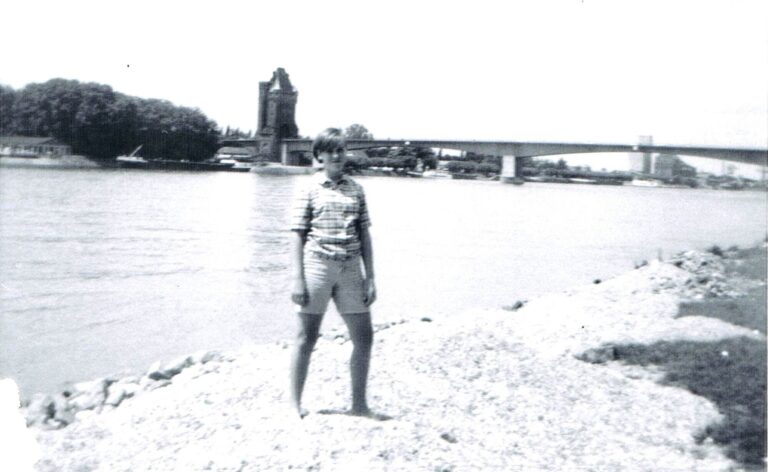
Not far from there was the Nibelungen Bridge, stretching across the Rhine River. At the time, it was simply part of the landscape, something we saw without fully understanding its history or significance. It connected one side to the other, steady and unchanged, while everything around it felt like it was always moving.
I never would have imagined then that, years later, I would find myself writing about a fallen soldier connected to that very place. At that time, it was just a bridge.
Looking back, it feels different now. The bridge has become more than just a place I once stood. It is a reminder of where I was, who I was with, and a time that continues to surface in pieces. The photograph of me with the bridge behind me holds that moment in a way memory alone cannot.
While we lived in Worms, my sister Lori was born. Around the same time, we got a long-haired dachshund from the family of one of Dad’s coworkers. We named him Hans. He was part of our family for three to four years and part of our Worms story.
Then came the orders.
Dad was reassigned to Vietnam, and suddenly our time in Germany was cut short. We were supposed to stay for three years, but we had to leave early. It was one of the hardest departures I can remember.
The song “Leaving on a Jet Plane” was popular at the time, and it became my personal theme as we left Worms. I can still hear it now, not just as a song, but as a feeling. It carried the weight of goodbye, of leaving friends behind, and of not fully understanding when or if paths would cross again.
At that age, leaving felt sudden and unfinished. There was no real way to hold on to the life we had there, only memories that followed us home.
The month before we left, we took a family trip to Switzerland and Italy, camping along the way. We traveled winding mountain roads where it sometimes took an hour to go twelve miles. In Italy, we camped by the beach for three days. Glenn and I got sunburned so badly that our skin blistered. We were supposed to continue on to Rome, but the pain was too much. We cried until Dad turned the car around, our 1967 Pontiac Catalina, and headed back.
After leaving Worms, we moved to Ocean Springs, Mississippi, while Dad served his one-and-a-half-year tour in Vietnam.
Worms stayed with me.
Even now, when I hear “Leaving on a Jet Plane,” I am taken back to that moment in time. Not just the leaving, but everything that came before it. The friendships, the freedom, the feeling of belonging somewhere far from where we started.
What once felt like everyday places and moments have taken on a different meaning over time. Things I did not understand then have found their way back to me in unexpected ways.
It was never just about getting on a plane.
It was about leaving a piece of life behind, knowing it would only exist that way in memory.